

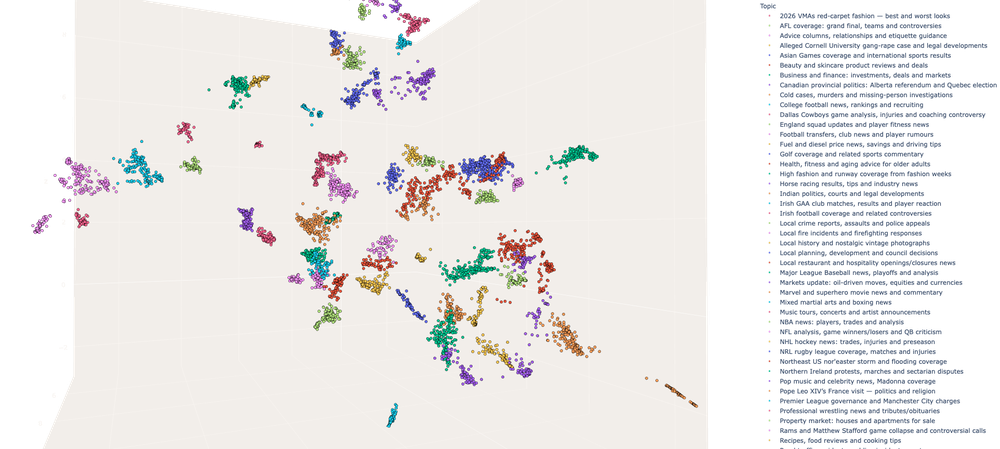
The map is a snapshot. The question here is: what changed in a month?
Explore the latest maps:
- English Context Cube: https://aeternalabs.ai/media/plots/3dplot_topic_en.html
- Swedish Context Cube: https://aeternalabs.ai/media/plots/3dplot_topic_sv.html
From September to October
Our previous article focused on the structure of the media conversation: how related subjects can gather together, how stories can sit between different topic clusters, and why English and Swedish media deserve to be examined in their own linguistic contexts.
The new snapshots give us another opportunity to examine that diversity.
The English topic inventory includes coverage of the AFL Grand Final and Australian football, Canadian politics and Alberta separatism, the Kansas City Chiefs, Middle Eastern conflicts, financial markets, AI and infrastructure: stories from the entire anglophone world. Alongside these are more internationally relevant subjects from celebrity fashion and skincare back to more localized ones like road incidents, charity events and community sports.
The Swedish inventory, being more localized in nature, includes national political leadership, parliamentary representation, political negotiations, energy prices, housing market updates, local weather, harvest festivals and a wide variety of local and international sports and cultural coverage.
These are not just different headlines. They reflect the breadth of the media environments represented in each language.
What stands out in the latest English snapshot?
As of October 21, the English topic inventory spans several distinct areas of coverage.
Politics and international affairs include Canadian political debates, German elections and leadership issues, and conflicts involving Yemen, the Houthis and Iran. Business and technology coverage includes central bank policy, inflation, AI-related market themes, infrastructure, data centres and automotive developments.
Sport is represented across several distinct audiences: Australian football, English football, basketball, horse racing, American football at national and college level. Entertainment and lifestyle coverage ranges from seasonal events like London Fashion Week to perennial celebrity news, music events and beauty recommendations.
There is also a substantial local layer: roadworks, traffic incidents, local business developments, community fundraising and emergency reporting, all localized for any anglophone market.
This range is useful to keep in mind when considering what a media monitoring system should capture. A media landscape is not defined only by the stories receiving international attention. It also contains specialised interests and local conversations that are highly relevant to their audiences, making them especially attractive for campaigns in real estate, home services, events, recruitment & retail.
The Swedish picture: politics, energy and everyday life
The Swedish topic inventory provides a different slant to the same broad picture.
Major stories included national political leadership, election-related developments and negotiations between parties appearing alongside energy prices, fuel costs, housing transactions and personal finance. Local coverage includes weather forecasts, crime reporting, fire incidents, community events and lower-division sport.
Culture and lifestyle remain part of the picture, with book reviews, fashion, film, music, theatre and recipes represented as well.
For anyone monitoring media across languages, the point is not to assume that one set of topics is more important than another. It is to understand the particular combination of national issues, local interests and specialist coverage that makes up each information environment.
This is also why comparing language-specific maps can be valuable. The comparison provides a starting point for investigating differences in coverage, rather than assuming that translating the same categories will produce an equivalent view of each market.
The next question: what moves?
A single snapshot tells us which topics are represented in a collection of media content. A series of snapshots can help us investigate how that picture changes.
Let’s dive into Swedish:
What appears to have changed in Swedish media coverage?
- AI and technology remain prominent: Both cubes include AI-related coverage, suggesting continuity rather than a clearly new trend.
- Politics discussions evolve following elections: September’s context cube includes election politics, US politics and political commentary. The newer one explicitly includes national political leadership, new MPs and parliamentary representation, and political negotiations following elections.
- Energy and the economy remain relevant: September’s vector features global markets, stock market analysis and personal finance. October’s cube explicitly includes an uptick in energy prices, fuel costs and EU energy policy, alongside IPOs and investment guides.
- Housing and local life remain visible: Both cubes feature local property sales and community reporting. The newer list also explicitly identifies construction, housing development, restaurant launches and local welfare debates.
- Some topics become more relevant in October: Solar eclipse coverage, heatwaves and extreme weather across Europe, ice hockey preseason news and swimming competitions featuring Sara Sjöström appear in the older list but not the newer one.
- October takes some subject areas into more explicit territory: Immigration and voting rights, pension planning, harvest festivals, junior ice hockey and local weather forecasts are identifiable as distinct topics rather than lumped into broader clusters.
But the underlying principle remains: media monitoring becomes more useful when we can move beyond a static list and investigate relationships, differences and change. With that in mind:
Your campaign stays on brand, on track
For advertisers, changes in the media landscape raise a practical question: when the news moves on, does a campaign targeting a specific segment still reach the content it was designed for?
Let’s take Business & Finance as an example.
The English Context Cube offers an interesting example. Financial markets, investment analysis and personal finance feature across both snapshots, while the newer October snapshot explicitly includes energy prices, fuel costs and war coverage.
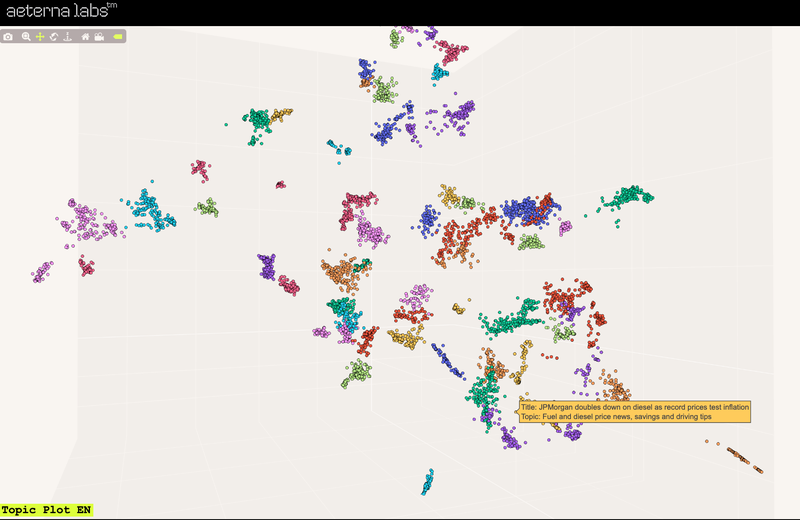
Fuel prices coverage is particularly interesting because these stories sit at the intersection of several conversations. Developments involving international conflict and geopolitics can influence energy markets, while political decisions shape the debate around fuel costs and energy policy. Yet reporting on fuel prices remains a distinct subject within that wider landscape, with clear relevance to business and finance.
For a campaign targeting Business & Finance, this is the kind of distinction that matters. An article about fuel costs and their economic implications may remain relevant to the campaign even when it touches on politics or international affairs. The surrounding conversation evolves, but the article's core subject can still align with the campaign's objective.
Contextual intelligence helps bridge the gap between a changing news cycle and consistent campaign relevance. Rather than relying solely on keywords or rigid categories, contextual analysis can help identify content according to what it is about and how it relates to the wider conversation.
The result is a more flexible approach to media monitoring and contextual targeting: one that can accommodate new stories and changing editorial environments without losing sight of the subject matter a campaign is intended to reach.
For advertisers, the goal isn't to make the news stand still. It's to keep campaigns relevant as the news moves.
Keep the map. Come back to it.
The Context Cubes remain available to explore free of charge. The links are unchanged, making it easy to return to the maps and examine the evolving media landscape.
If you explored them after our September article, revisit them now. Look at the topics represented, compare the English and Swedish views, and investigate the relationships that catch your attention.
And if this is your first visit, start with whichever language or subject interests you most.
Explore the latest Context Cubes:
🌐 English: https://aeternalabs.ai/media/plots/3dplot_topic_en.html
🇸🇪 Swedish: https://aeternalabs.ai/media/plots/3dplot_topic_sv.html
Bookmark the links and check back as the conversation evolves.
At Aeterna Labs, we’re interested in what contextual intelligence can reveal about the media environment — not just what is being discussed, but how stories relate to one another.
Have a campaign coming up, or interested in a Context Cube for another geo or contextual segment? Let’s chat.